
 ع
ع


A Fast Company Middle East analysis published in August 2026 frames carbon intelligence as the UAE’s latest competitive advantage, combining AI-driven monitoring with policy measures to turn emissions data into bankable assets that draw green investment. This focus builds on the nation’s longstanding Net Zero 2050 Strategic Initiative and recent regulatory steps that require major emitters to track and reduce greenhouse gases. The report highlights how such intelligence extends beyond basic accounting to deliver real-time insights for both government and corporate decision-making across the energy and industrial sectors.
Federal Decree Law No. 11, which entered into force last year, classifies entities emitting at least 500,000 metric tonnes of carbon dioxide equivalent annually as high emitters subject to mandatory reporting, according to a review by AGBI. The Ministry of Climate Change and Environment will maintain a national registry for carbon credits eligible for domestic and international trading under this framework. Cabinet Resolution No. 67 on carbon credits, effective since December 2024, further enables entities to purchase offsets to meet compliance thresholds while voluntary participants can earn credits for reductions below baseline levels.
TRST01 announced in May 2026 the launch of an AI-native carbon intelligence platform spanning India, Singapore and the Gulf, designating Dubai as its climate intelligence deployment centre for the Global South. The company appointed Dr. Ivano Iannelli, a climate finance specialist with two decades of regional experience, as strategic lead for its UAE operations. Dr. Iannelli stated in the announcement, “The carbon market does not need more brokers. It needs infrastructure: systems that turn raw emission data into auditable, bankable, and policy-aligned assets at the speed Article 6 now demands. The UAE is where technology, finance, and climate policy connect at global scale.”
The Eid Al Etihad 2025 report placed the UAE fifth globally in overall competitiveness while ranking it second worldwide in AI readiness and sixth in talent supporting the green transition. UAE authorities have allocated more than AED600 billion to renewable energy projects through 2050 under the national green hydrogen strategy that targets 15 million tonnes of production annually by mid-century.[[1]](https://www.arabianbusiness.com/world/uae-strengthens-global-leadership-in-competitiveness-ai-and-space-says-eid-al-etihad-2025-report) These benchmarks coincide with the rollout of carbon intelligence tools designed to reconcile rising demand from data centers with decarbonization targets.
Data centers in the UAE consumed 3 terawatt hours of electricity in 2025, equivalent to roughly 2 percent of national demand, yet their usage is projected to more than double to 12.6 terawatt hours by 2028, an Emirates NBD assessment found. A pilot project involving the Ministry of Energy and Infrastructure, Khazna Data Centers and Agility employs AI control technology from Phaidra to reduce cooling energy consumption by up to 40 percent. KPMG Middle East partner Fadi Al-Shihabi noted that policymakers are adopting a flexible approach that balances clean energy targets against immediate energy security requirements driven by digital infrastructure growth.
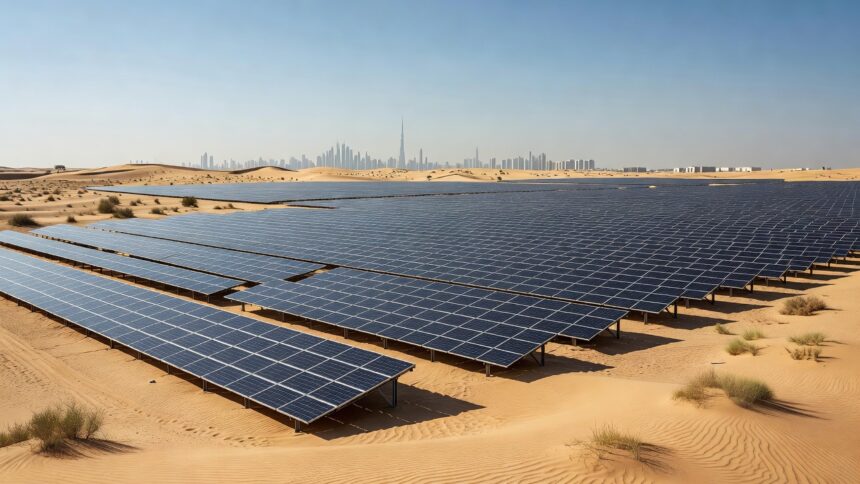
The UAE’s clean energy capacity is forecast to surpass 22 gigawatts by 2031 to accommodate both traditional economic expansion and new digital loads, according to government planning documents referenced in the Fast Company Middle East coverage. Carbon intelligence platforms such as TRST01’s offering and Farnek’s Emirates Carbon tool, launched in 2025, support compliance with the national Measurement, Reporting and Verification system while enabling offset purchases through verified international and forthcoming local credits. This infrastructure places the UAE at the center of emerging carbon markets that extend beyond its borders to serve sovereign registries across Africa and Asia.