ع



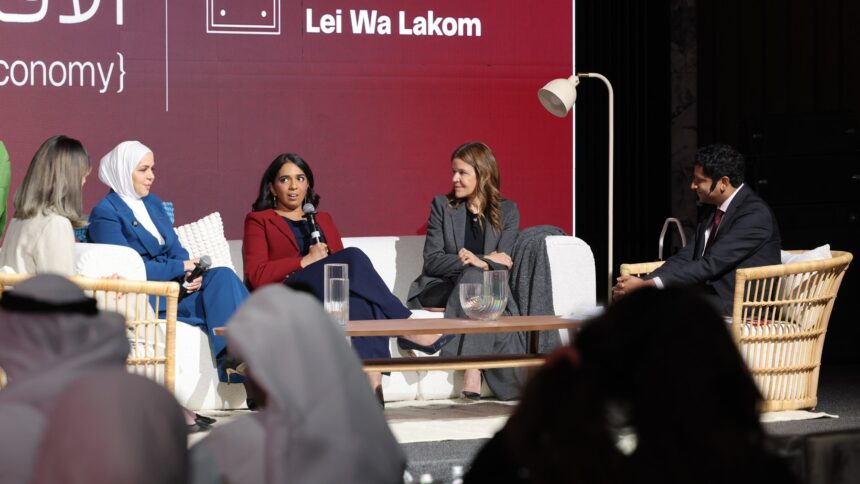
In a Diwaniya Media interview, His Majesty’s Ambassador to the State of Kuwait explains why he left legal practice for public service, describes his family’s welcome and encourages the next generation to stay curious.
Qudsi Rasheed, Ambassador to the State of Kuwait, was enjoying his career as a barrister when the opportunity to enter government service arose. He says the reason he took it was straightforward: he wanted to serve his country.
Speaking to Diwaniya Media at the Women & the Economy conference in Kuwait on 17 October, Rasheed reflected on that decision, the welcome his family has received and the importance of being willing to learn something new.
“Honestly, public service,” he said when asked what prompted his career change.
“I loved being a barrister. I did well at it, I enjoyed it, but when the opportunity came to serve my country, my nation, I thought that was what I wanted to do.”
His account connects a personal decision with a broader theme running through the interview: a career can change direction while building on the experience gained along the way.
From legal practice to diplomatic service
Rasheed’s official biography records his work as a barrister between 2008 and 2011, alongside an earlier period as a visiting lecturer at University College London and King’s College London.
When he joined the Foreign and Commonwealth Office in 2011, his first role was as a legal adviser. His move into public service therefore began within his existing profession, before expanding into policy and overseas diplomatic work.
Subsequent appointments took him to Brussels as an external relations counsellor and Beirut as head of the UK Syria Office. He later worked on multilateral policy and sanctions before serving as deputy head of mission in Cairo from 2021 to 2024.
That history gives more detail to the transition he described. His route from barrister to ambassador involved several roles, countries and areas of responsibility.
During the interview, Rasheed spoke positively about legal practice. He described work he enjoyed and believed he did well, but said the opportunity to serve his country persuaded him to pursue a different path.
“Kuwaitis have welcomed us into their homes and their hearts”
Asked about the differences between Kuwait and Cairo, Rasheed began with a similarity: the welcome offered by people in both places.
“People are kind, hospitable, open and warm in both places,” he said.
He also stressed that their histories and cultures were different, while describing both countries as having deep ties with Britain.
“I think both the countries have such a deep tie to the UK in different ways as well,” he said.
His answer then turned to his family. Rasheed said his wife and their young child had enjoyed living in Kuwait, describing the country as “extremely homely”.
“Kuwaitis have welcomed us into their homes and their hearts.”
The remark brought a personal dimension to a relationship usually described through official visits and agreements. Asked about his experience of Kuwait, the ambassador focused on hospitality, invitations into people’s homes and the welcome his family had received.
That sense of familiarity sits alongside a long institutional history. The two governments marked 125 years of official diplomatic relations in 2024, designating it the Year of the Kuwaiti-British Partnership.
Their joint statement identified cultural exchanges and education programmes among the ways they intended to develop the relationship, placing connections between people alongside cooperation between governments.
A relationship with roots in London and Kuwait
One of the clearest examples of Kuwait’s longstanding presence in Britain is its investment organisation in London.
According to the Kuwait Investment Authority’s history, Sheikh Abdullah Al-Salem Al-Sabah established the Kuwait Investment Board in the City of London in February 1953. Its mandate was to invest surplus oil revenues and reduce Kuwait’s dependence on a finite resource.
The board was replaced by the Kuwait Investment Office in 1965. The institution remains part of Kuwait’s international investment operations.
Its origins predate Kuwait’s independence in 1961, illustrating how far back some of the working relationships between the two countries extend. Investment professionals, students and officials have maintained connections that continue between high-level diplomatic occasions.
The relationship also encompasses a wide range of practical government work. At the 22nd UK-Kuwait Joint Steering Group, held in London in October 2025, ministers discussed trade, investment, defence and regional security.
They also oversaw agreements on healthcare cooperation and hydrographic surveying, covering areas that include health systems, training and maritime matters.
Those subjects illustrate the breadth of the ambassador’s working environment. Alongside formal diplomacy, the bilateral relationship involves specialists, institutions and businesses working together in different sectors.
Career advice for a changing world
Asked for one piece of advice for the next generation of women and men, Rasheed replied: “Be confident and be creative.”
He went on to encourage taking risks, changing careers when the time is right and continuing to learn. Those themes have practical relevance beyond diplomacy.
The World Economic Forum’s Future of Jobs Report 2025 drew on responses from more than 1,000 employers representing over 14 million workers across 55 economies. Respondents expected 39% of workers’ existing skills to change or become outdated between 2025 and 2030.
The report also identified creative thinking, adaptability, curiosity and lifelong learning among skills expected to become more important.
Those findings represent employers’ expectations across multiple economies, rather than a Kuwait-specific forecast. They provide wider context for Rasheed’s emphasis on remaining open to unfamiliar work and ideas as professional demands change.
His own experience illustrates one possible route: entering a new organisation through an existing professional skill, then taking on different responsibilities over time. Legal expertise provided his starting point in government before his career expanded into other diplomatic roles.
Rasheed’s advice did not prescribe a particular profession. It focused on how people approach decisions and opportunities throughout their working lives.
For the former barrister now serving as Britain’s ambassador to Kuwait, the habits worth carrying forward were “asking questions, learning new things and, like I say, taking risks.”