ع



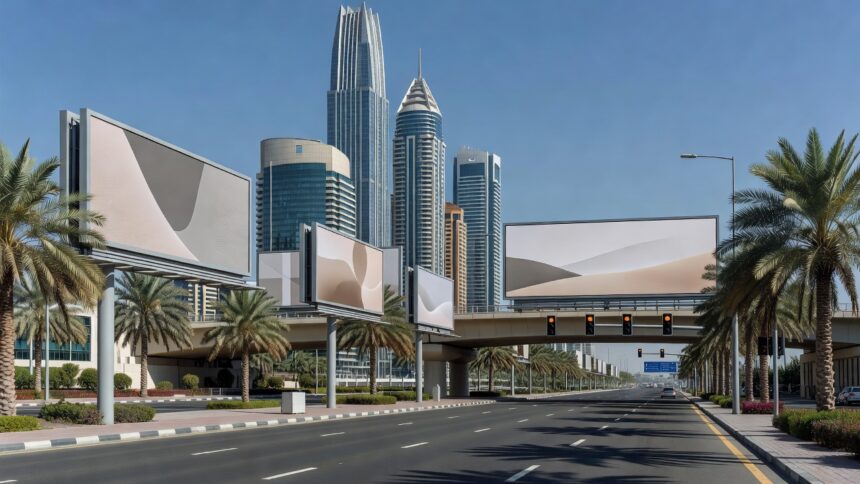
The manual, released by the Roads and Transport Authority, establishes detailed standards covering the types of images permitted, measurements, lighting, dimensions and approved locations for outdoor advertisements across Dubai. Any deviation from these guidelines requires exceptional approval from a technical committee appointed jointly by the RTA and Dubai Municipality, the authority’s documentation states. The updated rules seek to ensure that all outdoor advertising contributes to rather than compromises the safety of pedestrians and road users while maintaining the overall aesthetic standards of the urban environment.
According to the manual’s provisions, certain freestanding signages must be positioned at a reasonable setback distance from traffic signals to avoid any potential confusion. Advertisements are prohibited from imitating traffic control devices such as traffic lights or from featuring dominant colours that could compete with those used on large directional signs. The guidelines further specify that advertisements must not incorporate reflectors which might be mistaken for traffic devices during nighttime hours, a stipulation designed to prevent road safety hazards.
Additional requirements outlined in the document emphasise the need for advertisements to remain legible with a recommendation for clear fonts measuring at least 150 millimetres in height. The manual advises against the use of large areas of red in illuminated displays due to their potential to distract drivers. These specifications form part of a broader framework that the Roads and Transport Authority developed in collaboration with municipal and tourism authorities to align outdoor media with the city’s regulatory environment.
The introduction of these standards coincides with ongoing efforts to regulate commercial signage in commercial areas, where shop owners are now required to adhere to specific formatting rules derived from the 2024 manual. Only one trade name is permitted on each storefront, with signage required to be displayed horizontally and Arabic text positioned above the English equivalent, according to subsequent enforcement directives. Dimensions must remain proportionate to the storefront without excessive height, width or thickness, while lighting levels follow approved standards that prohibit bright white backgrounds.
Dubai’s out-of-home advertising sector has witnessed substantial investment, including a Dh1 billion partnership announced in May 2026 between Hills Advertising and Mada Media to digitise 94 premium static locations into digital platforms, Mada Media reported. This transformation aligns with the objectives of the Dubai 2040 Urban Master Plan by integrating advanced technologies while upholding the aesthetic guidelines established in the manual. The partnership focuses on converting bridge assets into digital out-of-home platforms that deliver enhanced engagement without compromising the visual harmony of the cityscape.
Mansoor Al Sabahi, CEO of Mada Media, stated in connection with the digitisation initiative that the approach leverages digital technologies while preserving the visual identity and urban aesthetics of the emirate. The manual’s framework provides the regulatory backbone for such developments, ensuring that all outdoor advertising contributes positively to Dubai’s urban landscape. Industry stakeholders have begun aligning their operations with these updated parameters to support both safety priorities and the emirate’s long-term vision for its public spaces.