 ع
ع

The Emirates News Agency reported that Hamad Al Kaabi headed the UAE delegation at the event co-hosted by the OECD Nuclear Energy Agency and the United States Department of Energy. Representatives from the Ministry of Energy and Infrastructure, the Federal Authority for Nuclear Regulation and the Emirates Nuclear Energy Company joined Al Kaabi for sessions that drew ministers, government officials and industry leaders from more than 30 countries. Discussions centred on the requirements for scaling new nuclear projects, ranging from financing models and supply chain resilience to workforce training and regulatory frameworks capable of overseeing advanced reactor designs.
Al Kaabi addressed participants by underscoring the importance of converting international interest in nuclear power into concrete projects delivered at the necessary scale and speed. The Federal Authority for Nuclear Regulation director-general pointed to sustained national commitment and robust institutions as essential foundations, according to the Emirates News Agency. His presentation aligned with growing global attention on nuclear energy following the COP28 pledge to triple global capacity by 2050, a target the International Atomic Energy Agency has described as critical for meeting climate objectives while ensuring energy security.
Regulatory preparedness for technologies such as small modular reactors received particular emphasis during the UAE intervention. Al Kaabi outlined the enabling conditions that support nuclear expansion, including credible project execution, reliable financing mechanisms, secure nuclear fuel supplies and the development of a skilled national workforce, the Emirates News Agency stated. The conference provided a platform for member states to exchange best practices on adapting regulatory systems to emerging nuclear applications while maintaining the highest safety and security standards.
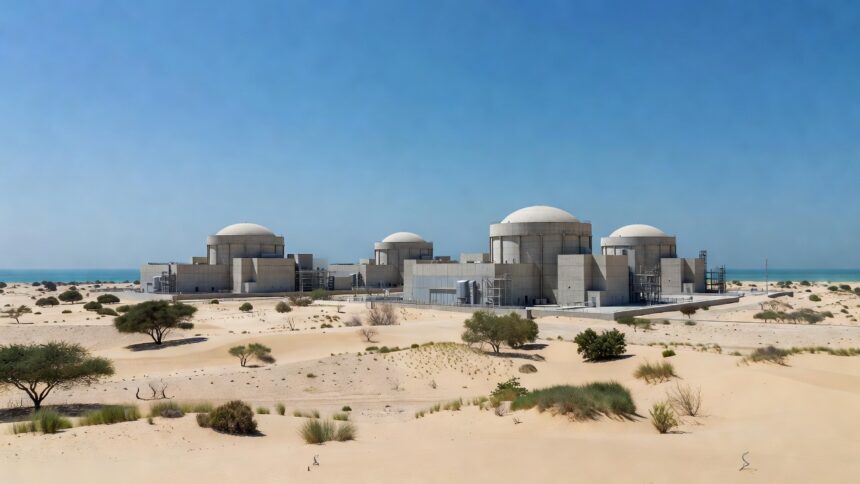
The delegation drew on the UAE’s own operational experience to illustrate these principles in practice. All four units of the Barakah Nuclear Power Plant have reached commercial operation, supplying approximately 25 percent of national electricity demand with carbon-free baseload power, according to figures presented by Al Kaabi. Emirates Nuclear Energy Company data places the plant’s annual generation at 40 terawatt hours while preventing 22.4 million tonnes of carbon emissions each year, a contribution that has helped lower natural gas consumption for power generation to a 13-year low in Abu Dhabi.
Long-term planning, competent organisations and the cultivation of domestic expertise proved central to the UAE’s message at the gathering. Al Kaabi noted that technology alone cannot guarantee success without these supporting elements, a lesson drawn from more than a decade of regulatory and operational development under Federal Authority for Nuclear Regulation oversight. The authority’s framework has earned repeated recognition from the International Atomic Energy Agency, including praise for its transparent response to operational incidents and its overall commitment to international benchmarks.
Participation in the Paris conference builds on the UAE’s established partnerships with nuclear leaders such as France, whose companies contributed engineering and fuel expertise to the Barakah project under agreements dating back more than a decade. The Emirates News Agency indicated that such collaborations continue to inform the UAE’s exploration of next-generation applications, including potential uses of nuclear energy for hydrogen production. Industry assessments from the OECD Nuclear Energy Agency project that global nuclear capacity could double by 2050 if financing, regulatory and supply-chain barriers are addressed in a coordinated manner.