ع



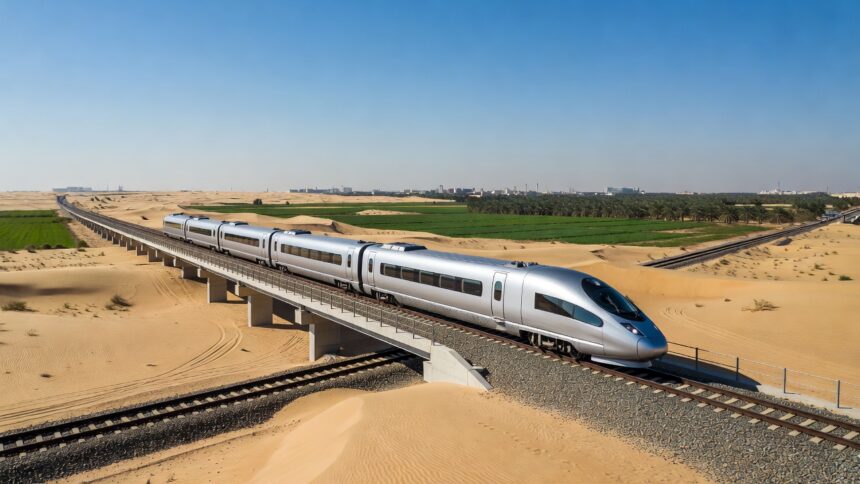
Gulf News reported that two Russian expats put the newly launched Etihad Rail passenger service to the test on its first day of operation between Dubai and Abu Dhabi. Dmitrii Mednikov drove a car from Dubai to Abu Dhabi while his friend Rodion boarded the train at Al Yalayis Station bound for Mohamed Bin Zayed City Station. When the pair compared arrival times the train had reached its destination about four minutes earlier than the car. Rodion told the publication, “We came here to compare, who will be faster, train or car. And the train won.”
Dmitrii noted the practical advantages beyond the narrow margin in arrival times. “It is definitely easier and more comfortable to be sitting in a train than stuck in traffic in a car or spending a lot of time finding a parking spot,” he said. He added that during peak hours the train would definitely be the fastest option. Rodion, who travelled in Comfort Class, described the experience as quiet and smooth despite the high speed.
The Dubai-Abu Dhabi rail journey takes approximately 57 to 64 minutes at an average speed of 200 kilometres per hour, according to transport comparisons published by Expat Media in early October 2026. By contrast, the same trip by car routinely requires between 90 and 120 minutes once traffic delays are taken into account. Fares for the rail service begin at Dh39 for a one-way Comfort Class ticket and Dh109 for Premium Class, the same assessment found. The train offers free Wi-Fi, power outlets and fold-down tables throughout its carriages.
Etihad Rail launched the Dubai-Abu Dhabi segment on September 30, 2026, extending an earlier Abu Dhabi-Fujairah route that opened in June of the same year. The operator has stated that the network will include 10 passenger stations by the end of March 2027 as part of a phased rollout. Al Yalayis Station in Dubai connects directly to the existing metro system, allowing travellers to continue journeys across the emirate without changing to road transport.
Dubai’s Roads and Transport Authority figures show the metro network has carried more than 300 million passengers in recent years, reflecting growing adoption of rail options within the city. Abu Dhabi is advancing separate metro development plans designed to link with the national rail network and reduce private vehicle use in the capital. Industry analyses indicate that inter-emirate rail services form one element of a wider strategy to address road congestion that frequently slows highway travel between the two cities.
Condé Nast Traveler associate editor Sophia Dyer, who rode the service shortly after launch, reported that the carriages feature high-end finishes and allow passengers to work or relax rather than focus on driving. She noted the route provides views of industrial zones, farmland and desert landscapes not normally seen from the highway. Future high-speed trains on the same corridor are expected to cut the journey time to 35 minutes once that phase is introduced.