
 ع
ع


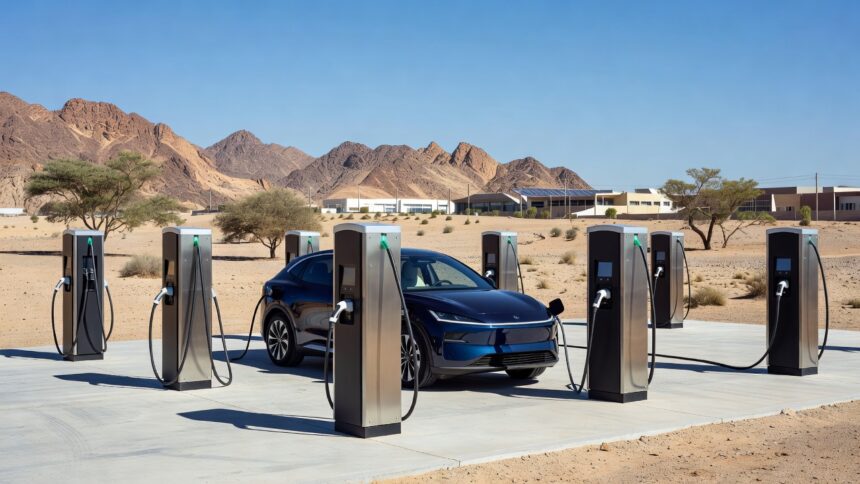
The Ministry of Transport, Communications and Information Technology set charging fees at 50 baisa per kilowatt-hour for stations with a capacity of up to 90 kilowatts, 90 baisa for those between 91 and 180 kilowatts, and 120 baisa for chargers exceeding 180 kilowatts. The ministry issued the tariff structure in coordination with the Authority for Public Services Regulation and the Oman Net Zero Centre. Officials determined the rates after completing a detailed economic and operational assessment of charging stations across the sultanate.
That assessment sought to balance affordability for drivers with the need for financial sustainability among station operators, according to the ministry. The new fees form part of a broader effort to regulate Oman’s expanding electric vehicle charging sector while improving price visibility for users. Surveys of EV owners and industry participants helped shape the final pricing framework, the ministry added.
Ministry figures show that the cost of charging under the new rates will stay below expenses associated with operating gasoline-powered vehicles, maintaining the economic incentive for EV adoption. The introduction of fees follows a period of free or unregulated access at many stations and aligns with national sustainability targets. Arabian Business data placed the number of public and private EV chargers in Oman at around 160 as of 2025.
Shell Oman Marketing and First Electric Vehicle Company currently operate charging points in the market, a ministry statement said. Several additional operators have entered planning and feasibility phases that include site assessments, technical reviews and grid connection coordination. The Porsche and Shell partnership, announced in 2025, aims to install 133 new charging points across Oman by the end of 2026, expanding the network significantly.
The regulated tariffs arrive as Oman accelerates its transition toward lower-emission transport under the Oman Vision 2040 framework, which emphasises economic diversification and environmental protection. The Oman Net Zero Centre has coordinated multiple initiatives to support EV infrastructure as part of the country’s commitment to reach net-zero emissions by 2050. Authorities expect the fee structure to encourage further private investment while preventing market distortions.
Implementation begins on the first day of October, giving owners and operators a brief adjustment window before the charges apply uniformly. The ministry will monitor uptake and operator compliance in the initial months, with potential adjustments based on performance data. This step represents the latest in a series of measures to build a viable EV ecosystem in the Gulf state.