
 ع
ع


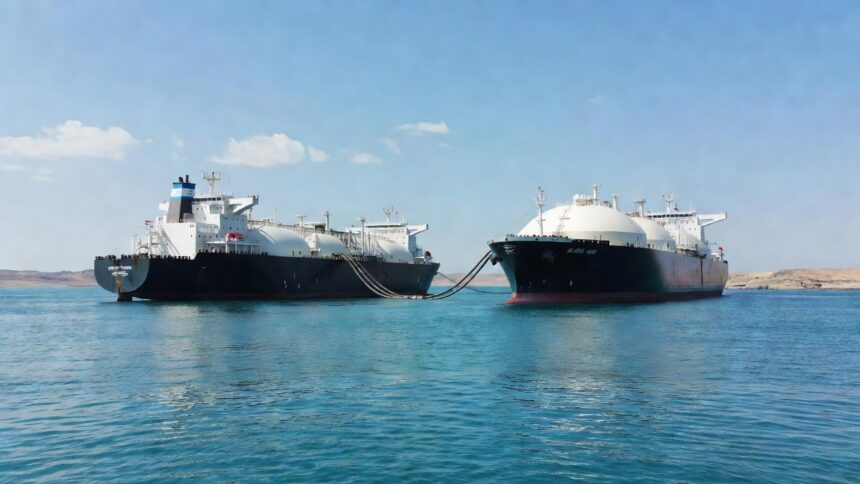
Three liquefied natural gas cargoes loaded from Qatar and the United Arab Emirates have been transferred between ships outside the Strait of Hormuz in recent weeks for delivery to customers in India and Japan, according to ship-tracking data cited by Reuters on Wednesday. The transfers represent an unusual practice for LNG, which typically avoids such operations unlike crude oil shipments, as the Iran conflict that began in late February has sharply curtailed tanker traffic through the strategic waterway. A Reuters assessment found that the disruptions have cut average daily transits through the strait by 88 percent since early March, contributing to a doubling of Asian LNG spot prices.
The LNG carrier GasLog Shanghai, which Reuters said was involved in an incident while exiting the Strait of Hormuz, completed a ship-to-ship transfer with the GasLog Savannah in late August off the coast of Oman. Additionally, the QatarEnergy-controlled Al Rekayyat tanker, hit by a projectile near the strait in early July according to the same report, conducted a transfer in mid-August on the east coast of the UAE with another Qatari vessel, the Tembek. The cargo, originally loaded at Ras Laffan, reached India’s Dahej terminal on Aug. 31, Kpler data showed.
A third transfer involved the ADNOC-controlled Mraweh, which loaded LNG at Das Island in early August before handing over the cargo to the LNG Enugu off Oman, Reuters reported, citing Vortexa and Kpler tracking. The LNG Enugu was en route to Japan’s Futtsu terminal as of the latest data. ADNOC declined to comment on the operations while shipping firm BW Group and Japanese trading house Marubeni, joint-venture owners of the LNG Enugu, did not respond to requests for comment.
Shell’s June assessment projected that global LNG trade, which reached 422 million metric tons in 2025, would likely remain flat through 2026 due to the Hormuz disruptions that have shut in around one-fifth of monthly LNG supply. The energy major noted that Asian LNG imports fell nearly 4 percent in the first half of the year to 127.70 million tons compared with the prior period, according to Kpler figures. Recent escalation, including U.S.-Iran exchanges of fire, has pushed Asian spot LNG prices to a five-month high near $24.60 per million British thermal units, traders told Bloomberg on Tuesday.
Qatar, the world’s top LNG exporter, has seen its Ras Laffan facilities damaged in the conflict, with repairs potentially taking years and reducing export capacity by about 17 percent, a CSIS analysis from early August found. The UAE has similarly adjusted operations, with ADNOC earlier notifying clients of options to load crude outside the Gulf to avoid the strait, Reuters reported in April. These ship-to-ship LNG moves extend that approach to gas cargoes as market participants seek to maintain supply flows amid ongoing risks.
No LNG vessels have transited the Strait of Hormuz since mid-July, according to S&P Global Commodity Insights data, amplifying reliance on alternative routing and transfers. The measures come as European and Asian buyers compete for available spot cargoes, with South Asian importers in particular seeking replacements for delayed Qatari term supplies. Industry participants continue to monitor developments in the region for any resumption of standard shipping lanes.