ع



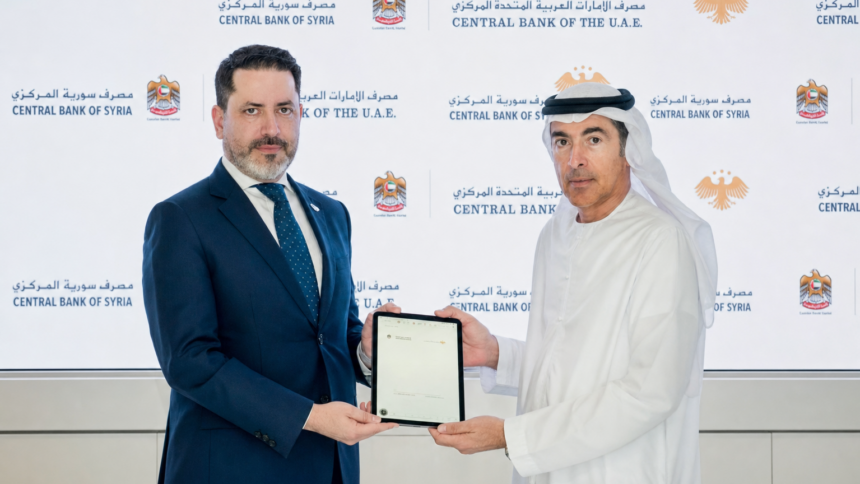
The memorandum was signed in Abu Dhabi by Khaled Mohamed Balama, governor of the Central Bank of the UAE, and Mohammad Safwat Abdel Hamid Raslan, governor of the Central Bank of Syria. The pact establishes a framework for bilateral cooperation focused on institutional capacity building and the exchange of expertise in financial and supervisory matters of mutual interest. It also facilitates the sharing of information related to regulatory frameworks between the two institutions.
According to the statement from the Central Bank of the UAE, areas of cooperation include payment systems, monetary policy, cash management and innovative financial technologies. The agreement further encompasses climate risk management and sustainable finance along with financial inclusion, financial literacy initiatives, credit information systems, reporting mechanisms and risk management frameworks. Cooperation will also extend to licensing of financial activities and institutions, regulatory enforcement, compliance measures and consumer protection.
The Central Bank of the UAE said in the statement that Balama described the memorandum as reflecting shared interests in advancing financial and regulatory cooperation. “The MoU reflects our shared interest to advancing cooperation in financial and regulatory areas, as part of efforts to support the resilience of the financial system, enhance the efficiency of the financial infrastructure, and keep pace with developments in the financial technology sector,” Balama said. He added that the agreement represents an important milestone in the exchange of expertise and knowledge while hoping it creates broader opportunities for financial institutions in both countries and strengthens the financial sector’s contribution to economic growth and development.
Raslan for his part noted the importance of the agreement for banking ties between the two countries, the Central Bank of the UAE statement reported. “The signing of the Memorandum of Understanding with the Central Bank of the United Arab Emirates represents an important step towards deepening banking cooperation between the two countries and opening broader avenues for joint work in the areas of banking supervision and regulation, payment and transfer systems, and the development of banking infrastructure,” Raslan said. The Syrian central bank governor attached particular importance to advancing financial inclusion, building institutional capacity and strengthening regulatory frameworks through the pact.
The memorandum arrives as the Central Bank of Syria anticipates foreign capital inflows exceeding 1 billion dollars for the establishment of new banks, according to statements Raslan made to the Syrian Arab News Agency in September 2026. Raslan outlined licensing requirements that include applicants’ experience, reputation and financial solvency along with the need for a strategic banking partner holding at least a 10 percent stake. Foreign investors would be permitted to retain up to 60 percent of paid-up capital in foreign currency with protections for profit transfers and the removal of restrictions on foreign currency transactions.
This pact forms part of expanding UAE-Syria economic relations with non-oil trade between the two countries reaching a record 1.4 billion dollars in 2025, a 132 percent increase from the previous year, according to UAE Minister of State for Foreign Trade Thani Al Zeyoudi. Syrian President Ahmad Al-Sharaa has projected the Syrian economy to grow to 50 billion dollars in 2026 from 32 billion dollars in 2025 as the country seeks to reintegrate with regional financial networks, Al-Sharaa told SANA during a visit to the UAE in September 2026. The Central Bank of the UAE has also pursued similar preliminary agreements with the central bank of Morocco focused on regulatory frameworks and potential payment system linkages.