
 ع
ع


Indian exporters have accelerated a strategy of building foundational components in India before transferring them to the UAE for final processing, a move designed to reclassify products as Emirati origin and secure lower US import duties. The approach has gained traction in Jebel Ali and Sharjah free zones, where companies establish last-mile facilities for assembly, packaging and finishing. According to an AGBI report citing the UAE chapter of the UAE-India Business Council, this model allows firms to add sufficient local value to satisfy thresholds of up to 40 percent while preserving cost advantages from Indian production. The trend reflects broader efforts to navigate evolving trade barriers following the return of the Trump administration.
Faizal Kottikollon, chairman of the UAE chapter of the UAE-India Business Council, told AGBI that companies are setting up facilities quickly in the specified free zones to achieve the required value addition on semi-finished goods shipped from India. Textiles and jewellery have emerged as the leading sectors adopting the model, with participants bringing core materials from Indian plants for final touches in the UAE. The report distributed via enterpriseam.com framed the practice as build in India and finish in the UAE, highlighting its role in preserving access to the US market. Kottikollon added that the shift had already begun in response to tariff pressures.
The UAE faces US duties averaging around 10 percent, significantly below rates applied to many Indian-origin goods under the new tariff regime. By meeting rules of origin through UAE-based finishing, products can qualify for preferential treatment as Emirati exports. AGBI noted that the facilities focus on the last-mile side of production, enabling rapid compliance without relocating entire manufacturing lines from India. This hybrid model has drawn participation from micro, small and medium-sized enterprises seeking to scale exports.
India-UAE bilateral trade reached USD 101.25 billion in fiscal year 2025-26, the second consecutive year above the USD 100 billion mark, according to India’s Commerce Ministry figures. The two countries have set a target of USD 200 billion in annual trade by 2032, supported by the Comprehensive Economic Partnership Agreement signed in 2022. UAE investments in India totalled USD 25.59 billion, positioning the Gulf state as the country’s seventh-largest foreign investor, Central Statistical Bureau data shows. The agreement has eliminated tariffs on a wide range of goods, facilitating the cross-border movement of semi-finished products.
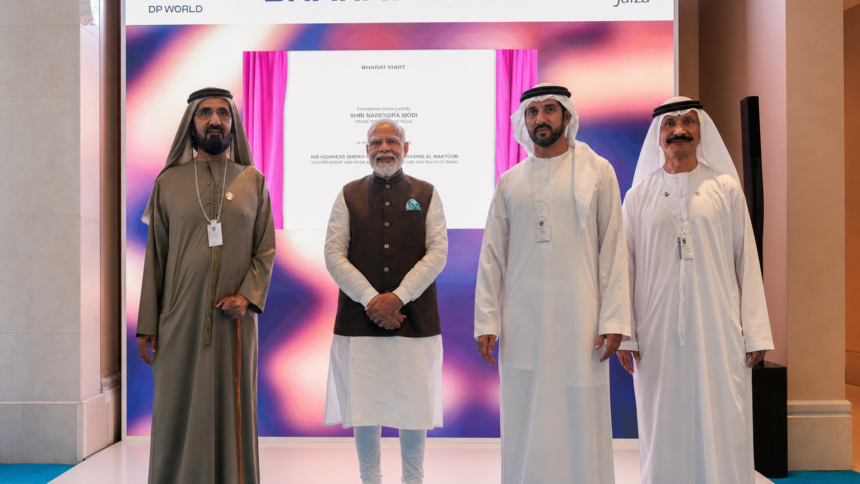
India’s minister of commerce and industry Piyush Goyal stated during a visit to the UAE that the forthcoming Bharat Mart facility would serve as a game changer for micro, small and medium-sized enterprises by expanding export opportunities. The mart, scheduled to begin operations in the first quarter of 2027, is projected to boost trade volumes between the two countries by nearly one-third. Speaking at the conclusion of the ministerial trip, Goyal emphasised the platform’s potential to help smaller Indian businesses grow into larger exporters. The development aligns with ongoing coordination under the CEPA framework.
Larsen & Toubro, an Indian engineering and construction major, has secured multiple power transmission orders in the Middle East that now account for 40 percent of its total order book, the company said in a statement. Such cross-border activity illustrates the deepening industrial ties that support hybrid production models across sectors. EnterpriseAM reported that additional Indian contractors continue to establish GCC hubs in the UAE, drawn by a regional project pipeline exceeding USD 2 trillion. The combined infrastructure and manufacturing momentum has encouraged more firms to integrate Indian production with UAE finishing capabilities.