
 ع
ع


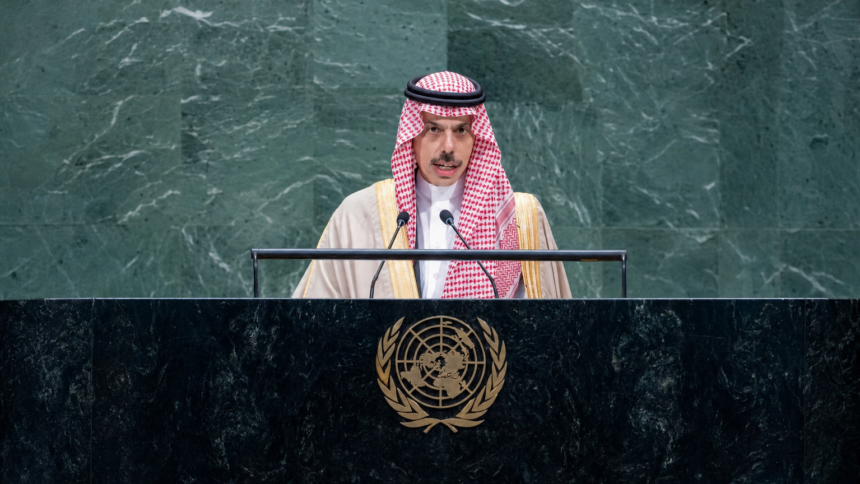
Saudi Foreign Minister Prince Faisal bin Farhan Al Saud told the United Nations General Assembly on Saturday that the Strait of Hormuz must revert to the conditions in place before Feb. 28 without any imposed fees or restrictions. The minister urged protection of freedom of navigation through international waterways and rejected their use as instruments of pressure or threat by any party. According to a report by Xinhua, Prince Faisal bin Farhan stressed that the security of the Gulf region forms an integral part of broader regional and global stability.
The call comes amid ongoing disruptions that began after the United States and Israel launched a military strike against Iran on Feb. 28, 2026. Iran subsequently disrupted shipping through the critical chokepoint, according to multiple accounts of the conflict’s impact on maritime traffic. Saudi Arabia has positioned the restoration of prewar rules as essential to preventing further harm to international trade routes.
The Strait of Hormuz normally carries about 20 million barrels of oil per day, roughly 20 percent of global petroleum consumption, along with a significant share of liquefied natural gas.[[1]](https://straitofhormuz.report/is-oil-flowing-through-the-strait-of-hormuz) A maritime monitoring assessment found that commercial ship arrivals have fallen to around 3 percent of the pre-crisis baseline of 74 vessels per day as of late September. War-risk insurance premiums have risen to approximately 15 times peacetime levels, data from the same monitoring service shows.
Recent tanker-tracking information from Kpler and Bloomberg indicates that crude oil flows through the strait have recovered to levels topping 13.5 million barrels per day in the week leading up to the speech, though still below full capacity.[[2]](https://www.intellinews.com/iran-s-grip-on-hormuz-slips-as-oil-flows-top-13-5mn-b-d-471293/) Saudi Arabia has increased Gulf loadings, with exports averaging more than 5 million barrels daily in September, according to separate Bloomberg compilations. These partial recoveries have occurred despite persistent restrictions that prompted the Saudi intervention at the United Nations.
Prince Faisal bin Farhan extended the call to other vital passages, including the Bab al-Mandab Strait, the Red Sea and the Gulf of Aden. “The kingdom stresses the importance of guaranteeing the protection of freedom of navigation in all international waterways, foremost among them the Strait of Hormuz, the Bab al Mandab Strait, the Red Sea, and the Gulf of Aden,” he said in the address carried by Khaleej Times. The minister added that the kingdom rejects any party’s use of these passages as a tool for pressure in a manner inconsistent with international law.
The foreign minister described the international community as having been absent from its responsibilities in confronting threats to peace and security. He voiced support for de-escalation initiatives, including those advanced by Qatar and Pakistan, during the general debate of the 81st UN General Assembly session. Saudi Arabia maintains that stability in the Gulf directly influences global energy security, international trade and supply chains, according to the text of the remarks reported by Saudi Gazette.