
 ع
ع


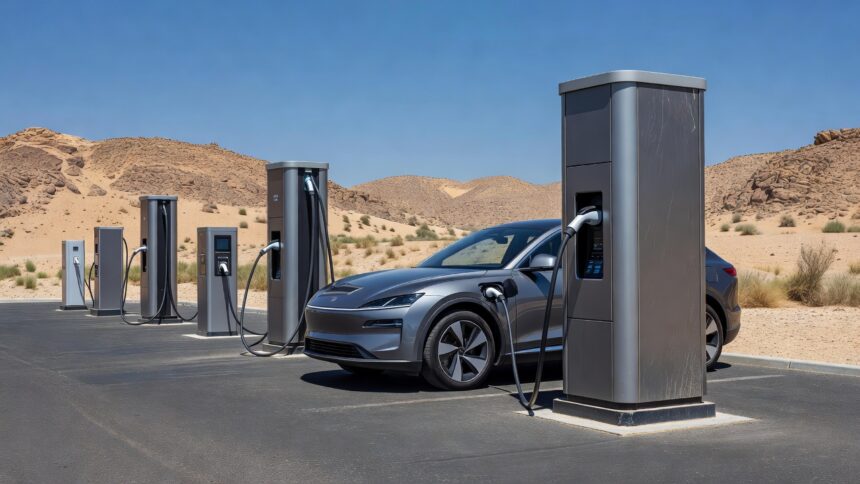
The Ministry of Transport, Communications and Information Technology has set charging fees at 50 baisa per kWh for stations with capacity up to 90 kilowatts. The rate increases to 90 baisa per kWh for chargers between 91 and 180 kilowatts and reaches 120 baisa per kWh for units of 181 kilowatts or greater. These tariffs will take effect on October 1, 2026 under the framework published this week.
The pricing structure was prepared in coordination with the Authority for Public Services Regulation and the Oman Net Zero Centre, according to the ministry announcement. Authorities based the rates on a comprehensive study of economic and operational factors at charging stations throughout the country. The assessment sought to balance affordability for users with commercial viability for operators and investors.
Oman registered more than 5,900 electric vehicles in the first half of 2026, the Ministry of Transport, Communications and Information Technology reported. The public charging network now exceeds 160 points and carries a target of 350 stations by the end of 2027. A Mordor Intelligence assessment found the Oman electric vehicle market is projected to grow from USD 115.98 million in 2026 at a compound annual growth rate of 30.09 percent through 2031.
Shell Oman Marketing and First Electric Vehicle Company currently operate charging points in the sultanate, Times of Oman reported. Several new operators are completing planning and feasibility work that includes site reviews, technical studies and grid connection arrangements. The ministry has launched the Shahin national platform to supply EV users with unified information on station locations, availability, charger types and approved fees.
Porsche Centre Oman and Shell Oman signed an agreement last year to install more than 130 chargers by the end of 2026, the companies said in a joint statement. The partnership covers high-performance DC stations at fuel sites and additional destination chargers at key locations. These projects are expected to increase network capacity in line with the new regulated pricing.
The tariff decision forms part of Oman’s net zero strategy advanced through the Oman Net Zero Centre, the ministry stated. Officials have emphasised that transparent pricing will encourage wider electric vehicle adoption while maintaining investment appeal for charging infrastructure. The measures represent an initial step toward formal regulation of a sector that has expanded rapidly in recent years.