ع



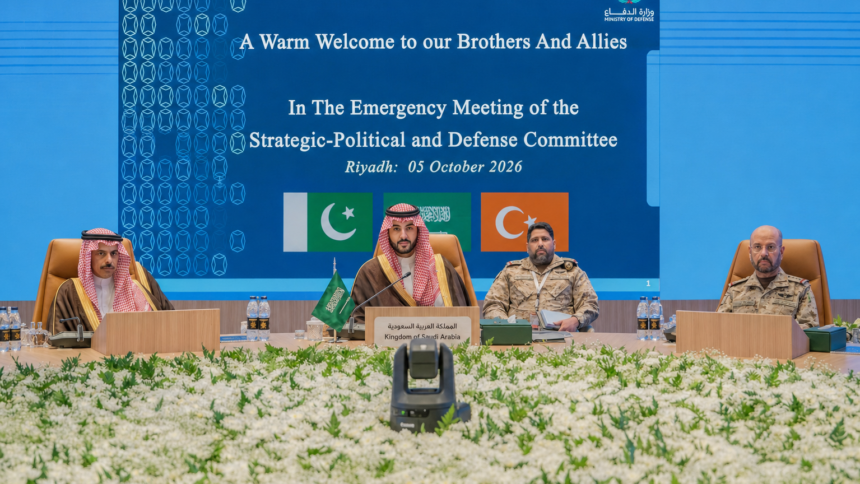
The Turkish Defense Ministry clarified that troop movements to Saudi Arabia as part of collective defense measures will adhere to domestic laws, a point underscored in a joint statement issued after an emergency meeting of the alliance in Riyadh. According to the Saudi Arabian Ministry of Defense, the three nations agreed to immediately implement their commitments by providing armed forces and capabilities for rapid deployment to the kingdom. The decision responds directly to a series of attacks by Yemen’s Iran-aligned Houthis, which have targeted Saudi territory in recent weeks and prompted the activation of the pact signed in August.
A joint communique emphasized that the security of each participating state forms an integral part of the collective security of all three countries, with deployments governed by their respective national legislation. A Reuters dispatch reported that Turkey’s contribution centers on defensive and technical support, including military equipment, intelligence sharing and weapons systems rather than large ground forces. Turkish officials have indicated that any expansion beyond existing technical deployments requires parliamentary approval, expected to come later in October following the legislature’s recent reopening.
Türkiye has maintained technical teams, air defense systems and electronic warfare assets in Saudi Arabia since 2025 to safeguard critical infrastructure such as energy facilities, according to a senior official cited by Middle East Eye. Plans now include sending additional equipment, technicians, emergency response teams and a limited contingent of combat forces once legislative steps are completed. The support will focus on protecting sites including Riyadh, the holy cities of Mecca and Medina, and sections of the East-West oil pipeline, without extending to direct intervention in Yemen.
The Mecca Joint Defense Agreement, signed by Saudi Arabia, Türkiye and Pakistan in August 2026, treats an armed attack on one as an attack on all and has moved quickly from framework to operational phase. A Financial Times assessment placed the combined active-duty military personnel of the three countries at roughly 1.14 million, highlighting their significant collective capacity. Saudi Defense Minister Khalid bin Salman described the activation as a measure for collective deterrence against the Houthis and those supporting them.
Turkish Foreign Minister Hakan Fidan joined his counterparts and military chiefs at the Riyadh meeting to discuss specific contributions to Saudi defensive capabilities. A report from The National noted that while the pact accelerates deployment timelines, each country’s legislation will dictate the parameters and pace of implementation. Officials have stressed the mission remains limited to territorial defense of Saudi Arabia rather than offensive operations further afield.
Parliamentary ratification of the full pact is anticipated in the coming weeks, building on a 2010 bilateral agreement that already permits certain technical deployments. The Turkish Defense Ministry has reiterated that all actions will proceed strictly within legal bounds to enhance military integration and readiness. This coordinated response marks the first operational test of the trilateral alliance amid ongoing regional instability.